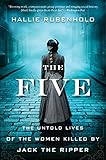
The five : the untold lives of the women killed by Jack the Ripper / Hallie Rubenhold.
Material type: TextPublisher: Boston : Mariner Books, Houghton Mifflin Harcourt, 2020Copyright date: ©2019Edition: First Mariner books editionDescription: viii, 333 pages, 8 unnumbered pages of plates : illustrations, map ; 21 cmContent type: text Media type: unmediated Carrier type: volumeISBN: 9780358299615; 0358299616Subject(s): Murder victims -- England -- London -- Biography | Working class women -- England -- London -- Social conditions -- 19th century | Whitechapel (London, England) -- History -- 19th century
| Item type | Home library | Call number | Status | Date due | Barcode |
|---|---|---|---|---|---|
| Book | A J M Library 868-5076 | 362.88 RUBE (Browse shelf) | Available | 66165 |
Includes bibliographical references (pages 302-323) and index.
Map: The Five's London -- Introduction: A tale of two cities -- Part I: Polly. The blacksmith's daughter ; The Peabody worthies ; An irregular life ; "Houseless creature" -- Part II: Annie. Soldiers and servants ; Mrs. Chapman ; Demon drink ; Dark Annie -- Part III: Elisabeth. The Girl from Torslanda ; Allmän kvinna 97 ; The immigrant ; Long Liz -- Part IV: Kate. Seven sisters ; The ballad of Kate and Tom ; Her sister's keeper ; "Nothing" -- Part V: Mary Jane. Marie Jeanette ; The gay life -- Conclusion: "Just prostitutes" -- A life in objects.
"The untold story of the women killed by Jack the Ripper--and a gripping portrait of Victorian London--[this book] changes the narrative of these murders forever. Polly, Annie, Elisabeth, Catherine, and Mary Jane are famous for the same thing, though they never met. They came from some of London's wealthiest and poorest neighborhoods, from the factory towns of middle England, and from Wales and Sweden. They wrote ballads, ran coffeehouses, lived on country estates; they breathed ink dust from printing presses and escaped human traffickers. What they had in common was the year of their murders: 1888. The person responsible was never identified, but the character created by the press to fill that gap has become far more famous than any of these five women. For more than a century newspapers have been keen to tell us that 'the Ripper' preyed on prostitutes. Not only is this untrue, as historian Hallie Rubenhold has discovered, but it has prevented the real stories of these fascinating women from being told. Now, by drawing on a wealth of formerly unseen archival material and adding full historical context to the victims' lives, Rubenhold finally sets the record straight, revealing a world not just of Dickens and Queen Victoria, but of poverty, homelessness, and rampant misogyny. They died because they were in the wrong place at the wrong time--but their greatest misfortune was to be born women."--Jacket.
There are no comments on this title.