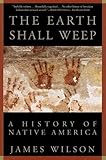
The Earth shall weep : a history of Native America / James Wilson
Material type: TextPublisher: New York, NY : Grove Press, [1998]Copyright date: ©1998Edition: First Grove Press editionDescription: xxix, 466 pages ; 24 cmContent type: text Media type: unmediated Carrier type: volumeISBN: 080213680X; 9780802136800; 0871137305; 9780871137302Subject(s): Indians of North America -- History | Indians of North America -- Government relations | Indians, Treatment of -- North America | Indians, North American -- historyDDC classification: 970.00497 LOC classification: E77 | .W54 1998b
| Item type | Home library | Call number | Status | Date due | Barcode |
|---|---|---|---|---|---|
| Book | A J M Library 868-5076 | 970 WILS (Browse shelf) | Available | 64175 |
Browsing A J M Library 868-5076 shelves, Shelving location: Non Fiction Close shelf browser

|

|

|

|

|

|

|
||
| 968 KNAU Nelson Mandela : | 97.93 ANON A warning / | 970 STUA The mysterious Maya | 970 WILS The Earth shall weep : a history of Native America / | 970.004 AllR All roads are good | 970.004 HAUP Tribes & tribulations : | 970.004 O'REI Killing Crazy Horse : |
Includes bibliographical references (pages 429-449) and index
I. Origins. This is how it was : two views of history ; Contact : in the balance -- II. Invasion. Northeast : One : 'You will have the worst by our absence' ; Northeast : Two : 'A new found Golgotha' ; New York and the 'Ohio Country' : 'We shall not be like father and son, but like brothers' ; Southeast : 'Get a little further : you are too near me' ; Southwest : Return of the white brother ; The far west : the burning world ; The Great Plains : the heart of everything that is -- III. Internal frontiers. Kill the Indian to save the man : assimilation ; New Deal and termination : "let none but the Indian answer" ; The new Indians -- Epilogue
"The Earth Shall Weep is a book with a pioneering approach that sets it apart from any history now on the market. Drawing not only on historical sources but also on ethnography, archaeology, Indian oral tradition, and his own extensive research in Native American communities, James Wilson sets out to make the Indian perspective on the past and the present accessible to a broad audience. He charts the collision course between indigenous cultures and European invaders, from the first English settlements on the Atlantic coast to the Wounded Knee massacre of 1890, explaining how Europeans justified a process that reduced the Native American population from an estimated seven to ten million to less than 250,000 in just four centuries. Wilson shows how old ideas about native people have continued to underpin government policy and popular perception in the twentieth century, leaving a painful legacy of ignorance and misunderstanding."--Jacket
There are no comments on this title.